
Effective management requires a clear view of your POS sales report to track daily performance. By monitoring labour costs, food wastage, and cash flow in real time, you can pivot your strategy instantly. This proactive approach turns raw data into a powerful tool for controlling your bottom line.
Many operators struggle because their information is trapped in disconnected systems. Using an automated restaurant reporting solution allows you to bridge these gaps effortlessly. This is the best restaurant reporting tool for owners who need to connect daily venue activity with smart decisions about staffing and purchasing. You deserve a system that works as hard as your team does.
Key Takeaways
- Treat your daily figures as a core operational habit rather than an administrative task.
- Monitor labour and food costs daily to identify financial pressure before it becomes a crisis.
- Use integrated systems to avoid the friction caused by fragmented data sources.
- Focus on reports that drive immediate action, such as adjusting rosters or menu pricing.
- Choose a platform that consolidates your metrics to save time and improve accuracy.
Turn Daily Venue Data into Decisions with Restaurant Reporting Software
Transforming raw venue data into actionable insights is the hallmark of a successful hospitality business. By leveraging top restaurant management software, you can move beyond guesswork and start making decisions based on hard evidence. This approach ensures your team remains focused on the metrics that actually drive profit.
A high-performing venue requires a unified view of its financial health. You should integrate your revenue, guest covers, and average spend into a single dashboard. Using an advanced reporting system for restaurants allows you to see how payment activity correlates with your busiest trading hours.
Separate trading patterns from one-off events
Distinguishing between a standard Tuesday and a one-off event is vital for accurate forecasting. Look for recurring trends in your data to identify when your venue naturally peaks. This clarity helps you avoid over-staffing during quiet periods or under-preparing for expected surges.
Which menu items, services and channels performed best?
Not all revenue is created equal. You must track which menu items provide the highest margins and which service channels, such as table reservation software, drive the most consistent traffic. Understanding these drivers allows you to refine your offering for maximum impact.
Did labour costs match the day’s trading demand?
Labour is often your largest variable expense. You need to ensure your staffing levels align perfectly with your actual covers. If your labour cost percentage spikes without a corresponding rise in revenue, you have an immediate operational issue to address.
Are refunds, discounts, voids or cash variances requiring investigation?
Exceptions like voids and refunds can hide deeper problems in your service flow. A robust restaurant performance tracking tool highlights these anomalies instantly. You should investigate these variances daily to protect your bottom line.
Morning: review the previous day and prepare staffing
Start your day by auditing the previous shift’s performance. Use this time to adjust your roster based on the data you gathered. Preparation is the best defence against operational friction.
During service: monitor live trading and capacity
Keep a close eye on your live trading metrics while the doors are open. Monitoring capacity in real-time allows you to pivot your strategy if demand exceeds your current resources. This proactive stance keeps your service smooth and your guests satisfied.
After service: record actions, exceptions and follow-up owners
The final step of your daily routine is the handover. Ensure every exception is documented and assigned to a specific owner for follow-up. This accountability loop is essential for long-term growth.
- Review daily revenue against labour costs.
- Identify top-performing menu items.
- Assign follow-up tasks for all voids and refunds.
- Adjust future staffing based on actual demand.
Choose Reports That Support Sales, Labour and Cost Control
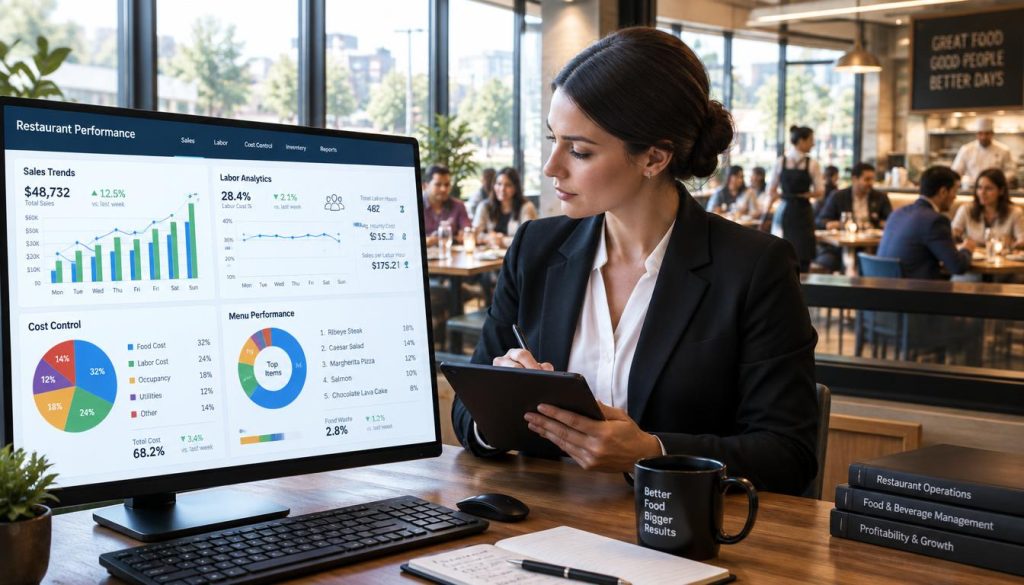
Transforming raw numbers into actionable insights starts with selecting the correct reporting metrics. Whether you are using a restaurant analytics platform or a more manual approach, your focus must remain on the data that drives profit. You need to identify which reports provide the most value for your specific operational needs.
Compare dine-in, takeaway, delivery and online ordering performance
You must segment your revenue by channel to understand where your growth originates. High volume in delivery might mask low margins, while dine-in performance indicates your true capacity usage.
Review item mix, modifiers, discounts and peak trading periods
An advanced reporting system for restaurants allows you to see exactly which items drive your bottom line. By tracking modifiers and discounts, you can spot trends that impact your food cost percentage.
Use an example: adjusting prep quantities after a weak weekday pattern
If your data shows a consistent dip in sales on Tuesday afternoons, you should reduce your prep quantities accordingly. This simple adjustment prevents unnecessary wastage and keeps your inventory costs lean.
Compare rostered hours with sales and service demand
Aligning your staff levels with actual customer flow is critical for profitability. Use your cloud-based restaurant software to map your busiest hours against your current roster.
Identify overstaffed periods without relying on guesswork
Look for gaps where your labour cost exceeds your revenue generation. Eliminating these inefficiencies is the fastest way to improve your daily margins.
Check award, payroll and timesheet requirements with the relevant Australian adviser
Always ensure your rostering practices remain compliant with local regulations. Consult your professional Australian adviser to verify that your scheduling meets all award and payroll obligations.
Track voids, refunds, cancellations, discounts and cash-up differences
Monitoring these exceptions is essential for loss prevention. You should review these figures daily to ensure your cash handling remains accurate.
Assign manager responsibility for unusual transactions
Accountability starts with clear oversight. Ensure that every void or refund is linked to a specific manager to maintain transparency.
Use audit trails and permissions in Hospoware or menumiz™ where those features are enabled and verified
Leverage the security features within your chosen best restaurant reporting tool to restrict access. Audit trails provide a clear history of who performed specific actions within your system.
Sales and channel performance
Reviewing your average cover and table turnover helps you understand if your channels are competing for the same capacity. This is a vital restaurant performance tracking tool for any growing venue.
Labour and roster variance
Compare your projected labour costs against actual spend to identify where your budget is leaking. Consistent monitoring prevents small variances from becoming large losses.
Payment reconciliation and exception activity
Reconcile your daily takings against your bank deposits to ensure no funds go missing. This process should be a non-negotiable part of your daily routine.
Stock usage, wastage and low-availability items
Track your inventory turnover to ensure your stock levels match your sales volume. High wastage often points to poor prep planning or over-ordering.
| Report Type | Operational Question | Accountable Role | Follow-up Action |
|---|---|---|---|
| Sales Mix | What are my top sellers? | Head Chef | Adjust menu pricing |
| Labour Variance | Are we overstaffed? | Venue Manager | Update roster template |
| Exception Report | Why were voids high? | General Manager | Staff training session |
Build a Reporting Routine That Leads to Better Actions
Transform your data into a management routine by defining which variances require immediate attention. Record every decision, assign a clear owner, and set a firm follow-up date to ensure accountability. This practice turns raw numbers into a centralized reporting culture that drives results.
When evaluating top restaurant management software, prioritise clear dashboards and role-based access. Confirm that your chosen cloud-based restaurant software integrates seamlessly with your existing POS, accounting, and payroll systems. Avoid platforms that hide underlying data behind complex interfaces.
An effective restaurant analytics platform provides value only when it changes your daily operating decisions. While gross and net profit margins offer financial context, your focus should remain on actionable daily metrics. Seek an automated restaurant reporting solution that eliminates manual spreadsheet work while keeping you in control of your venue.
Explore the capabilities of menumiz™ to see how integrated tools can streamline your operations. Consistent reporting builds a foundation for long-term success in the competitive Australian hospitality market.
How often should I review my restaurant reports? Daily reviews of key performance indicators help you catch issues before they impact your bottom line. Weekly and monthly deep dives provide the necessary context for long-term planning.
What integrations are essential for my software? Ensure your system connects directly to your POS, payroll, and inventory platforms to maintain data accuracy. This connectivity prevents manual entry errors and saves valuable time.
Can reporting software improve staff performance? Yes, by tracking labor costs and ticket accuracy, you can identify training gaps. Use these insights to mentor your team and foster a culture of excellence.











